
Published on: Apr 14, 2026 by Jennifer Harvey
Updated on: September 16, 2026
| Highlights: |
|
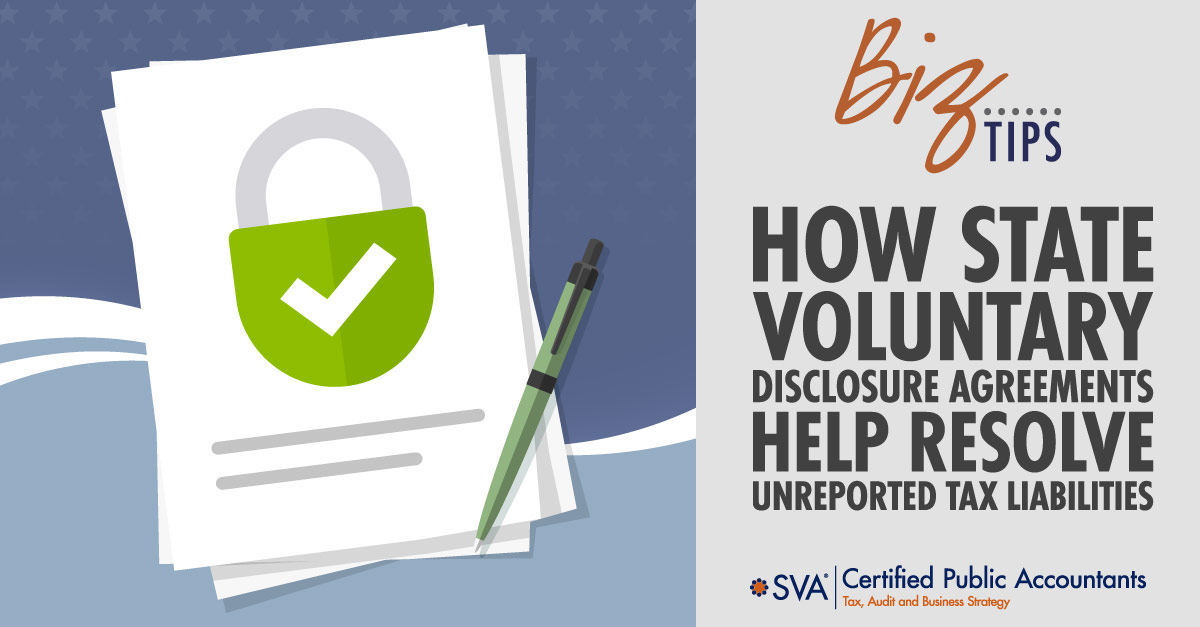
State voluntary disclosure agreements (VDAs) are programs offered by many states that allow businesses and individuals to proactively disclose previously unreported tax liabilities.
These agreements provide a pathway to compliance while often offering incentives such as reduced penalties and limited look-back periods. VDAs are especially relevant for taxpayers who have discovered that they have not filed or paid state taxes in jurisdictions where they have established nexus.
Entering a state VDA makes sense in several scenarios:
| Nexus Discovery | If a business realizes it has established nexus in a state (for example, through employees, property, or sales) but has not registered or filed returns, a VDA is a way to voluntarily come forward before the state initiates an audit or assessment. |
| Past Non-Compliance | Individuals or businesses who have failed to file state tax returns, either inadvertently or due to misunderstanding of filing requirements, may use a VDA to resolve outstanding liabilities. |
| Corporate Transactions | During due diligence for mergers, acquisitions, or financing, discovering past non-compliance can prompt entities to seek VDAs to clear up potential liabilities before closing. |
| Mitigating Penalties | Taxpayers who want to minimize exposure to penalties, interest, and extended look-back periods associated with non-filing. |
VDAs offer several advantages for taxpayers.
One of the primary benefits is reduced penalties, as most states significantly reduce or even waive penalties when taxpayers voluntarily disclose and pay outstanding liabilities before being contacted by tax authorities.
VDAs also typically include a limited look-back period, meaning states restrict the number of years for which back taxes must be paid (often three to four years) rather than imposing unlimited liability that could apply if non-compliance is discovered independently by the state.
In some cases, states may also provide interest relief by reducing the interest owed on unpaid liabilities. Completing a VDA offers taxpayers certainty and closure regarding prior tax obligations, helping them move forward with confidence and avoid unexpected future assessments.
Additionally, many states allow VDAs to be initiated anonymously through a representative, which preserves the taxpayer’s confidentiality during the early stages of the process.
While VDAs can be beneficial, there are still risks and factors to consider.
Full and accurate disclosure is required when entering into a VDA, and providing incomplete or fraudulent information may void the agreement and potentially lead to penalties or even criminal prosecution.
Another key consideration is that VDA programs vary by state, with each jurisdiction establishing its own eligibility rules, procedures, and benefits. As a result, understanding the specific requirements of each state involved is critical.
It is also important to note that VDAs generally apply only to state taxes and do not address federal tax liabilities, which must be handled separately.
Although VDAs are intended to resolve prior liabilities, states may still conduct audits to verify the information provided in the disclosure. Taxpayers must also consider the financial impact of the agreement, as they will still be responsible for paying back taxes and possibly interest, which can be significant.
Finally, resolving one tax exposure may reveal additional obligations, potentially triggering liabilities related to other taxes such as sales and use tax, payroll taxes, gross receipts taxes, or local taxes.
States typically administer VDA programs through their departments of revenue or taxation. The process generally includes the following steps:
| 1. Initial Contact | The taxpayer or their representative contacts the state, often anonymously, to express interest in a VDA. |
| 2. Application Submission | The taxpayer submits an application detailing their tax situation and the periods involved. |
| 3. Agreement Negotiation | The state reviews the application and negotiates terms, including the look-back period and penalty waiver. |
| 4. Disclosure and Payment | The taxpayer files required returns and pays the agreed-upon taxes, interest, and any applicable reduced penalties. |
| 5. Finalization | The state issues a closing agreement, confirming that the taxpayer is compliant for the disclosed periods. |
States may also require the taxpayer to register for ongoing compliance and continue filing and paying taxes in future periods.
State income tax voluntary disclosure agreements provide a valuable opportunity for taxpayers to proactively resolve past non-compliance, minimize penalties, and achieve certainty regarding state tax obligations.
Before proceeding, it’s important to consider the benefits, risks, and state-specific requirements. Reach out to SVA for help navigating this process.

Share this post:


Jennifer is a Senior Associate Accountant with SVA Certified Public Accountants
Get Weekly Biz Tips Delivered Straight to Your Inbox!





Madison, WI
1221 John Q Hammons Dr, Suite 100
Madison, WI 53717
(608) 831-8181
Milwaukee, WI
18650 W. Corporate Drive, Suite 200
Brookfield, WI 53045
(262) 641-6888
Colorado Springs, CO
10855 Hidden Pool Heights, Suite 340
Colorado Springs, CO 80908
(719) 413-5551



Copyright © 2026 SVA Certified Public Accountants | Privacy Policy | Cookie Policy | CCPA