
Published on: Sep 29, 2026 by James Emmerich, CPA, CVA
Updated on: October 5, 2026
| Highlights: |
|
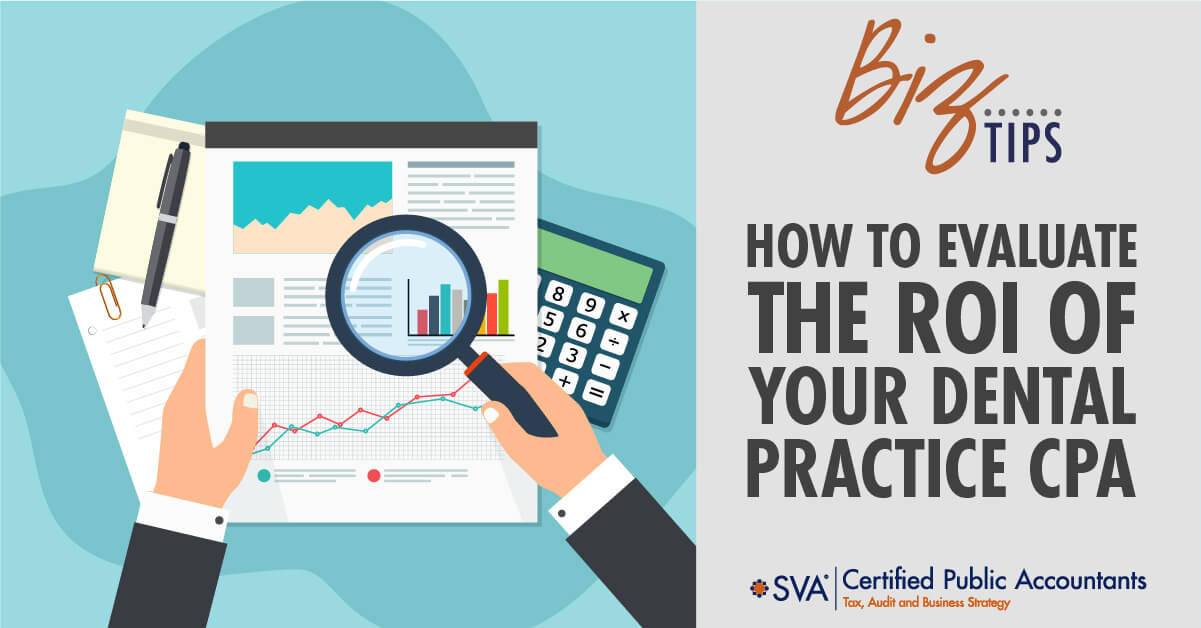
Most dental practice owners recognize the need for a CPA. But when evaluating the value of a CPA relationship, looking just at annual fees and tax preparation only tells part of the story.
A strong dental practice CPA can contribute to profitability, tax planning, major business decisions, risk management, and long-term financial goals. While some of that value can be measured in dollars, other benefits are harder to quantify.
The better question for practice owners is: What measurable financial and strategic value is my CPA helping create for my practice?
Before determining ROI, consider what you've actually engaged your CPA to do.
A CPA hired primarily for tax preparation and compliance shouldn't be evaluated against the same expectations as an advisor engaged for year-round financial planning. Depending on the relationship, services may include proactive tax planning, financial analysis, cash flow guidance, entity and compensation planning, acquisition analysis, expansion planning, and practice transition support.
Understanding the scope gives you a better starting point for determining whether you're receiving the level of value you expect.
Tax savings are among the easier components of CPA ROI to quantify.
Proactive dental practice tax planning could involve evaluating entity structure, retirement plan opportunities, the timing of income and deductions, capital expenditures, depreciation, and estimated tax payments. The appropriate strategies will depend on the practice and owner's individual circumstances.
One simple calculation is:
Estimated tax savings from planning ÷ annual CPA fees = tax-planning ROI
For example, if planning results in an estimated $15,000 in tax savings and the practice spends $7,500 annually on accounting, tax, and advisory services, those savings alone equal approximately twice the annual CPA fee.
Tax savings shouldn't be considered in isolation, however. The goal is to make sound financial decisions while evaluating the related tax implications, rather than pursuing a tax benefit that doesn't otherwise make business sense.
Receiving financial statements and receiving financial advice aren't necessarily the same thing. Much of the potential value comes from interpreting the numbers and deciding what to do with them.
A CPA familiar with dental practice financial management may help you examine areas such as provider productivity, staffing costs, supplies, laboratory expenses, overhead, operating margins, cash flow, and debt.
Suppose financial analysis identifies a recurring expense trend and changes made by the practice contribute to a $25,000 improvement in annual profitability. That improvement can be considered when evaluating the broader return from the CPA relationship.
Dental practice benchmarks can also provide useful context. Rather than treating benchmarks as rigid targets, use them to ask questions: Where are we outside typical ranges? Why? Is there a reasonable explanation? Is there an opportunity to improve?
Specialty, geography, provider mix, practice size, staffing structure, and growth stage can all influence the answer.
Some of the greatest returns from a CPA relationship may come from decisions that happen only occasionally.
Buying or selling a practice, opening another location, purchasing real estate, hiring an associate, adding a partner, taking on significant debt, or planning an ownership transition can involve substantial financial consequences.
An experienced advisor should help you understand cash flow implications, evaluate financing options, analyze tax consequences, structure a transaction, and identify risks before you make a commitment.
A single well-informed decision involving hundreds of thousands of dollars may provide significant value relative to several years of professional fees.
CPA ROI can also include costs that never occur.
Avoiding tax penalties, unexpected liabilities, cash flow problems, poorly structured transactions, compensation issues, or preventable planning mistakes has value even though it can be difficult to assign an exact dollar amount.
This is one reason CPA ROI shouldn't always be reduced to a single percentage. Some outcomes are easier to see after the fact, while good risk management may mean a costly problem never develops in the first place.
Consider who initiated the most important financial conversations during the past year.
Did your CPA bring tax-planning ideas to you before year-end? Did they flag unusual financial trends? Did they ask about upcoming purchases, hiring plans, growth opportunities, or ownership changes? Did they communicate changes that could affect your practice?
A relationship centered primarily on reporting past activity provides a different level of support than one that also helps you plan ahead.
The level of involvement you should expect also depends on the services included in your engagement. Some practice owners want their CPA focused primarily on tax compliance and reporting, while others choose to invest in more frequent planning, analysis, and advisory support. When evaluating the relationship, make sure your expectations align with the scope of services and fees you’ve agreed upon.
Rather than searching for one definitive ROI number, periodically evaluate your CPA across several categories:
| CATEGORY | WHAT TO EVALUATE |
| Tax Planning | Savings and proactive planning opportunities |
| Profitability | Improvements in margins, costs, and cash flow |
| Benchmarking | Quality of dental-specific financial insight |
| Financial Reporting | Accuracy, timeliness, and usefulness |
| Major Decisions | Value provided during significant business decisions |
| Risk Management | Problems or unnecessary costs avoided |
| Proactivity | Frequency and quality of forward-looking recommendations |
| Strategic Value | Contribution toward long-term practice goals |
Consider rating each area from one to five annually. The exercise can highlight both the value you're receiving and areas where the relationship could improve.
At your next meeting, consider asking:
For dental practice owners, the annual CPA fee is only one side of the equation. The more meaningful measure is what the relationship contributes to the financial health of the practice and the owner's ability to make informed decisions about what comes next.

Share this post:


James is a Principal with SVA Certified Public Accountants with expertise in the dental and veterinary industries. James advises his clients on budgeting, cash flow management and tax savings strategies. He is experienced in developing compensation models, buy-in and buy-out agreements, and benchmarking.
Get Weekly Biz Tips Delivered Straight to Your Inbox!





Madison, WI
1221 John Q Hammons Dr, Suite 100
Madison, WI 53717
(608) 831-8181
Milwaukee, WI
18650 W. Corporate Drive, Suite 200
Brookfield, WI 53045
(262) 641-6888
Colorado Springs, CO
10855 Hidden Pool Heights, Suite 340
Colorado Springs, CO 80908
(719) 413-5551


Copyright © 2026 SVA Certified Public Accountants | Privacy Policy | Cookie Policy | CCPA