
Published on: Jan 13, 2026 by Nicole Gralapp, CPA, CExP™
Updated on: September 2, 2026
| Highlights: |
|
In recent years, hospitality operators have been revisiting how they handle added fees on guest checks. Changing labor laws, shifting guest expectations, and updates related to tip taxation have prompted businesses to rethink their long-standing policies.
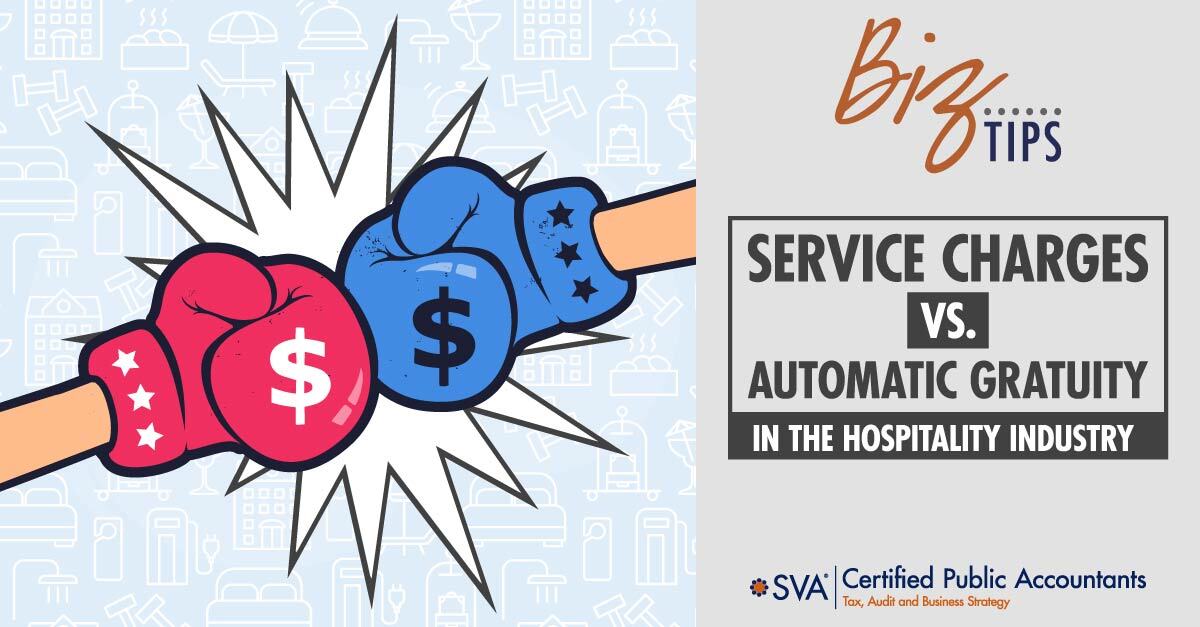
This Q&A will help you understand the difference between service charges and automatic gratuities so you can choose an approach that fits your team and business model best.
A service charge is a mandatory fee that a business adds to the bill. The company collects the fee and decides how it is used or distributed.
Automatic gratuity is also a preset amount that is commonly applied to large parties. However, it originated as a way to support servers managing big tables that require extra time and attention. Guests may still add an additional tip on top of it.
Traditional tips are voluntary amounts added by guests based on their personal experience. Under OBBBA, up to $25,000 of voluntary tips aren’t taxed for the individual. This has renewed interest among operators in reviewing their policies and considering how best to support their teams.
Service charges and automatic gratuity are considered wages. They run through payroll, appear on a W-2, and are subject to standard tax withholdings. Service charges and automatic gratuity are not considered tips and are not eligible for the OBBBA individual tax breaks. They also are not eligible for the employer tip credit.
It began as a practical way to protect servers from receiving very low tips on large, time-intensive tables. Big groups often require additional coordination, pacing, and attention. Automatic gratuity gave operators a way to support staff who took on those demanding sections.
Many still do, but preferences among employees have shifted. Some staff members prefer tip income instead of wages because the tax treatment is different. As a result, some businesses are experimenting with giving servers the discretion to use automatic gratuity on groups when they feel it’s appropriate verses mandates. This approach can motivate strong performance while still providing a safety net for unusually demanding parties.
|
Pros |
Predictable revenue for the business |
| Flexibility to distribute funds across all roles, not just servers | |
| Potential support for benefits or higher base wages | |
| Less income volatility for staff |
|
Cons |
Guests may perceive the fee as unclear unless well explained |
| Staff may feel less direct connection between service and income | |
| Staff do not receive the tip benefits created under OBBBA with service charges | |
| Requires clear communication to avoid misunderstandings | |
| Must be represented correctly to comply with tax rules |
|
Pros |
Helps servers handling large groups receive fair compensation |
| Encourages consistent tipping patterns | |
| Reduces guesswork for guests |
|
Cons |
Some guests may feel hesitant to add extra tips above the automatic amount that they otherwise would have tipped |
| Can add complexity to accounting because it’s treated as wages | |
| Staff do not receive the tip benefits created under OBBBA with automatic gratuity | |
| Occasionally confused with a service charge | |
| Some areas have rules that affect when and how it can be used |
Banquet operations often function differently. An automatic gratuity may be part of the contract, but it isn’t always paid directly to staff. Sometimes employers raise base wages instead and do not pass automatic gratuities through. Employees typically know their compensation structure before accepting the event shift.
No; each business must look at its own staffing model, financial structure, and competitive landscape. Operators also need to think about how their policies affect hiring: employees will compare opportunities, including how much income is taxed and how predictable pay feels.
Transparency goes a long way toward building trust on both sides.
Yes. Guests can always write in an additional amount. That added amount is treated as a traditional tip rather than wage income.
Choosing between service charges, automatic gratuity, or a hybrid model requires thoughtful evaluation. Each approach influences staff income, tax treatment, guest perception, employer tip credit and operational planning.
The best path depends on your business model, your team, and the expectations of your guests. Regularly reviewing your policy helps you stay competitive and aligned with both legal requirements and staff needs.

Share this post:


Nicole is a Principal at SVA Certified Public Accountants working primarily with closely-held businesses and individual clients. Nicole performs a variety of tax, assurance and business consulting functions. She provides clients with technical expertise in areas such as tax planning, financial reporting, financial projections, budgeting, financial and estate planning and review of internal controls. Her experience in the hospitality, restaurant, construction and professional services industries gives her the ability to consult with clients in a variety of areas.
Get Weekly Biz Tips Delivered Straight to Your Inbox!





Madison, WI
1221 John Q Hammons Dr, Suite 100
Madison, WI 53717
(608) 831-8181
Milwaukee, WI
18650 W. Corporate Drive, Suite 200
Brookfield, WI 53045
(262) 641-6888
Colorado Springs, CO
10855 Hidden Pool Heights, Suite 340
Colorado Springs, CO 80908
(719) 413-5551



Copyright © 2026 SVA Certified Public Accountants | Privacy Policy | Cookie Policy | CCPA