
Published on: Oct 08, 2026 by Evan Conroy
Updated on: October 8, 2026
| Highlights: |
|
Artificial intelligence is becoming more common in dental practices, but that doesn’t mean every office needs to overhaul its systems overnight.
For many practices, the best place to start is with everyday tasks that take time, require repetitive analysis, or depend heavily on manual follow-up. AI can help teams work through data faster, support administrative processes, and uncover information that may be difficult to spot manually.
The opportunity is less about adopting AI for the sake of having it and more about finding areas where it can solve a real business problem.
AI adoption can begin with relatively simple tasks. Generative AI tools can help draft emails, write job postings, summarize information, organize ideas, or work through scheduling challenges. These uses can help staff become more comfortable with the technology before moving into more advanced applications.
Over time, practices can use AI for workflows that run more consistently in the background, such as analyzing data, organizing information, or preparing work for employees to review.
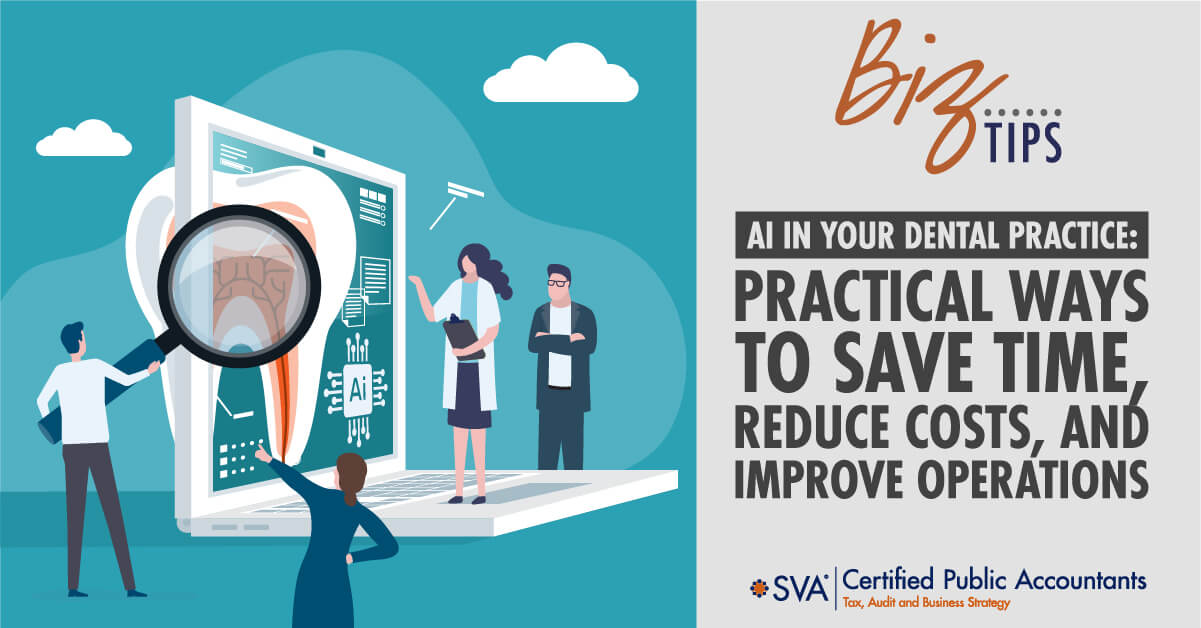
More advanced tools are also emerging within dentistry itself. AI can assist with imaging and diagnostics by identifying patterns on X-rays that a dentist can then review. It can also support insurance verification, patient communications, front-desk activity, note-taking, and business analytics.
The common thread is that AI works best as a support tool. It can help surface information, complete repetitive steps, or provide a first pass, while the dental team still applies professional judgment.
Supply expenses are one area where AI can help turn large amounts of information into something more useful.
Dental practices may receive pricing information from several suppliers, maintain product lists in spreadsheets, or compare options through buying groups. Reviewing all of that manually can be time-consuming.
AI tools can help organize supplier data into a spreadsheet, compare pricing across vendors, identify products with the largest savings opportunities, and run different scenarios.
For example, a practice could ask an AI tool to identify which supplies would create the greatest annual savings if purchasing shifted to another vendor. The tool could also help build formulas, compare pricing options, or model what might happen if costs change.
This doesn’t require someone to manually create every calculation from scratch. Instead, the team can spend more time reviewing the results and deciding whether a change makes sense.
Many dental practices already have valuable information sitting in spreadsheets, practice management systems, accounting software, and other platforms.
AI can make that data easier to analyze.
A membership plan is one example. A practice may want to track enrollment, reimbursement, utilization, or profitability but rely on a spreadsheet that requires regular updates and manual calculations.
AI can help turn that information into a dashboard or interactive tool that makes trends easier to see. It can also help practices test scenarios, such as what happens if membership grows, fees change, or certain assumptions are adjusted.
The value comes from getting to useful information faster. Instead of spending hours building formulas, creating pivot tables, or sorting through rows of data, practice owners and managers can spend more time interpreting what the information means for the business.
AI can also help reduce repetitive work across the front office.
Potential uses include:
An AI voice agent, for example, could potentially help handle basic scheduling requests when staff members are unavailable. Other tools may help identify outstanding follow-up items or surface information that employees would otherwise need to find manually.
These types of applications can help staff redirect time toward patients and higher-value work.
Because dental practices handle sensitive patient information, AI adoption should come with clear rules. Before expanding AI usage, practices should understand which tools employees are using, what information is being entered into them, and what protections are provided by each platform.
An AI governance policy can help define acceptable use across the practice. It can also outline which tools are approved, what types of data can be entered, and where additional review is needed.
Patient information deserves particular attention. Whether protected health information can be used within an AI system depends on the specific platform, its security controls, and the agreement the practice has with that provider.
Practices should also understand the difference between free consumer tools and paid business or enterprise-level platforms. Privacy protections can vary significantly, so sensitive information shouldn’t be entered into a tool without first understanding how that data is handled.
Buying AI software doesn’t automatically create value. A better approach is to identify a specific problem and then determine whether AI can improve it.
Maybe employees spend too much time comparing supply prices. Perhaps membership plan reporting takes hours each month. Maybe patient scheduling creates repeated administrative work.
Define the problem first, then decide what success should look like.
That could mean reducing the time spent on a task, lowering supply costs, improving scheduling efficiency, reducing manual errors, or giving managers faster access to information.
Practices can also monitor how often AI tools are being used and which workflows employees rely on most. That can help identify successful use cases that may be worth expanding across the team.
Dental practices don’t need to adopt every available AI tool at once. Instead, start with one or two areas where the benefit is easy to identify. Give employees clear guidance, review the results, and learn from how the tools are actually being used.
As the practice becomes more comfortable, AI can expand from simple assistance into more automated workflows and industry-specific tools.
The goal is to use the technology where it can make the practice stronger: saving staff time, improving access to information, reducing repetitive work, and supporting better decisions.
AI will continue to change quickly. Practices that begin building familiarity now will be in a better position to evaluate new capabilities as they emerge and decide which ones truly support their patients, employees, and long-term business goals.

Share this post:


Evan is a Principal and the Practice Director of Business Applications at SVA Consulting, where he brings over a decade of experience in helping organizations grow and succeed. With a focus on operational excellence, strategic planning, and team leadership, Evan is dedicated to finding practical solutions that make a real difference for his clients.
Get Weekly Biz Tips Delivered Straight to Your Inbox!





Madison, WI
1221 John Q Hammons Dr, Suite 100
Madison, WI 53717
(608) 831-8181
Milwaukee, WI
18650 W. Corporate Drive, Suite 200
Brookfield, WI 53045
(262) 641-6888
Colorado Springs, CO
10855 Hidden Pool Heights, Suite 340
Colorado Springs, CO 80908
(719) 413-5551



Copyright © 2026 SVA Certified Public Accountants | Privacy Policy | Cookie Policy | CCPA